7. Membrane-Associated Components and Mechanisms
7.1. Introduction
BioCRNpyler supports modeling genetic circuits with membrane-associated features using computational tools. This functionality enables users to construct and simulate genetic circuits that incorporate membrane components and mechanisms within simplified cell-free system models.
BioCRNpyler’s membrane-associated features allow for the representation of inducer dynamics, including diffusion across membranes or transport via channels and transporters. These membrane-associated features facilitate facilitate the design and refinement of models that connect mechanistic biology with computational analysis, bridging the gap between conceptual design and experimental implementation in synthetic biology. The following provides an overview of the membrane proteins currently included in BioCRNpyler.

Membrane components and mechanisms. The figure includes key membrane components and the pathways of their mechanisms. The membrane crystal structures depicted in the figure were adapted from previously published studies: [Song1996], [Sun12], [Jost18], [Cheung09]. [1]
Membrane Components
The following membrane-associated components are available in BioCRNpyler:
DiffusibleMolecule: Represents a molecule that can diffuse freely across or within compartments, such as ions, gases, or small polar molecules.IntegralMembraneProtein: Represents a protein embedded permanently within the membrane, spanning the lipid bilayer.MembraneChannel: A subtype of integral membrane protein that represents a membrane protein that uses passive or facilitated transport to move specific ions or molecules across the membrane via a pore.MembranePump: A subtype of integral membrane protein that represents an active transport protein that moves ions or molecules against their concentration gradient using energy (e.g., ATP).MembraneSensor: A subtype of integral membrane protein that represents a protein embedded in the membrane that detects environmental or intracellular signals (e.g., ligand binding, voltage change) and initiates a cellular response, such as activating a signaling cascade.
Membrane Mechanisms
The following membrane-associated mechanisms that are available in BioCRNpyler:
Simple_Diffusion: Models the passive movement of small, nonpolar molecules across the membrane, driven by concentration gradients, without the need for membrane proteins or energy input.Membrane protein-mediated mechanisms:
Membrane_Protein_Integration: Models the insertion and proper orientation of proteins into the membrane, ensuring their structural and functional integration within the lipid bilayer.Simple_Transport: Models the passive movement of substrates through membrane pores/channels along concentration gradients without requiring energy input.Facilitated_Transport_MM: Models the passive movement of substrates along concentration gradients by binding to carrier proteins that undergo conformational changes without requiring energy input.Primary_Active_Transport_MM: Models the active movement of substrates against concentration gradients by binding to membrane pumps, which undergo conformational changes driven by energy input (e.g., ATP).Membrane_Signaling_Pathway_MM: Models the environmental sensing through a signaling pathway involving a sensor kinase and phosphorylation of a response regulator protein, enabling adaptive cellular responses.
Compiling Chemical Reaction Networks with Membrane Features
The membrane modeling capabilities of BioCRNpyler allow users to build complex chemical reaction networks (CRNs) involving membrane-associated components and transport mechanisms from modular, high-level specifications.
This following figure illustrates the various options available for modeling transport and two-component signaling within BioCRNpyler. It specifically highlights the membrane components (orange boxes), their corresponding mechanisms (green boxes), and species (blue boxes).
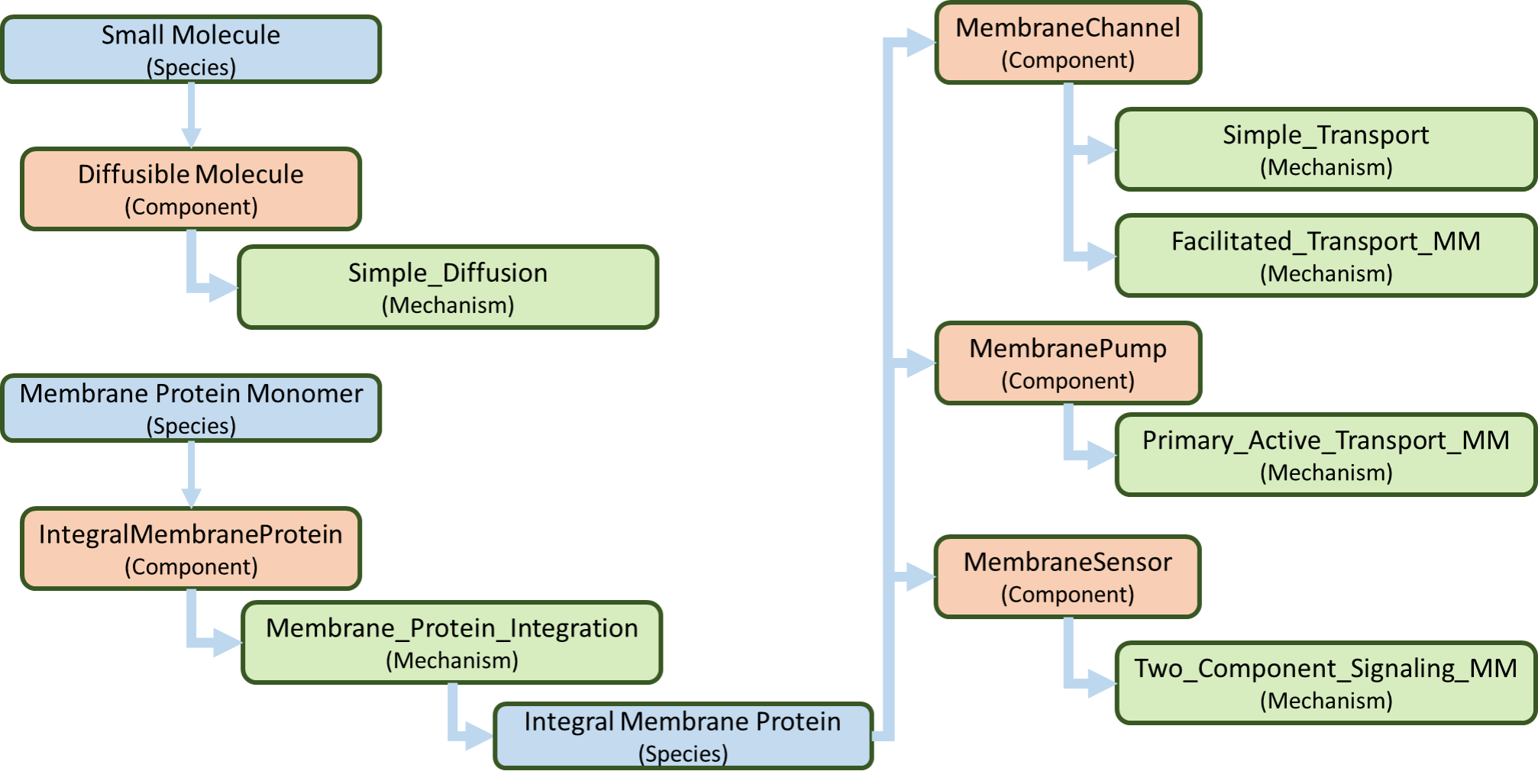
Flowchart illustrating membrane protein features and modeling specifications. Specifications include biomolecular components and modeling assumptions (mechanisms) relevant to the simulation and analysis of membrane- associated processes.
7.2. Diffusible Molecules
Component: DiffusibleMolecule
A diffusible molecule refers to a class of molecules that can pass through cell membranes without assistance. Examples of such molecules include gases like oxygen (O2) and carbon dioxide (CO2), as well as small polar but uncharged molecules. In contrast, larger uncharged molecules and charged molecules require membrane proteins for transport across the membrane.
The following code defines a diffusible molecule called S:
# Define component
S = DiffusibleMolecule('name')
Unless otherwise specified, the species S will reside in the internal
compartment. The membrane component DiffusibleMolecule will
then create a species product, which is a copy of S but located in the
external compartment.
Mechanism: Simple_Diffusion
Simple diffusion allows molecules to cross membranes passively down their concentration gradient. Simple diffusion is the most basic mechanism by which molecules can traverse a membrane, commonly referred to as passive diffusion. In this process, a molecule can dissolve in the lipid bilayer, diffuse across it, and reach the other side. This mechanism does not require the assistance of membrane proteins, and the transport direction is determined by the concentration gradient, moving from areas of high concentration to areas of low concentration.
In BioCRNpyler, the DiffusibleMolecule component uses the
mechanism Simple_Diffusion, which is defined as follows:
# Mechanism
mech_tra = Simple_Diffusion()
transport_mechanisms = {mech_tra.mechanism_type: mech_tra}
Example 1: Diffusion of nitrate
Construct a chemical reaction network (CRN) for the diffusion of nitrate (NO3) across a membrane.
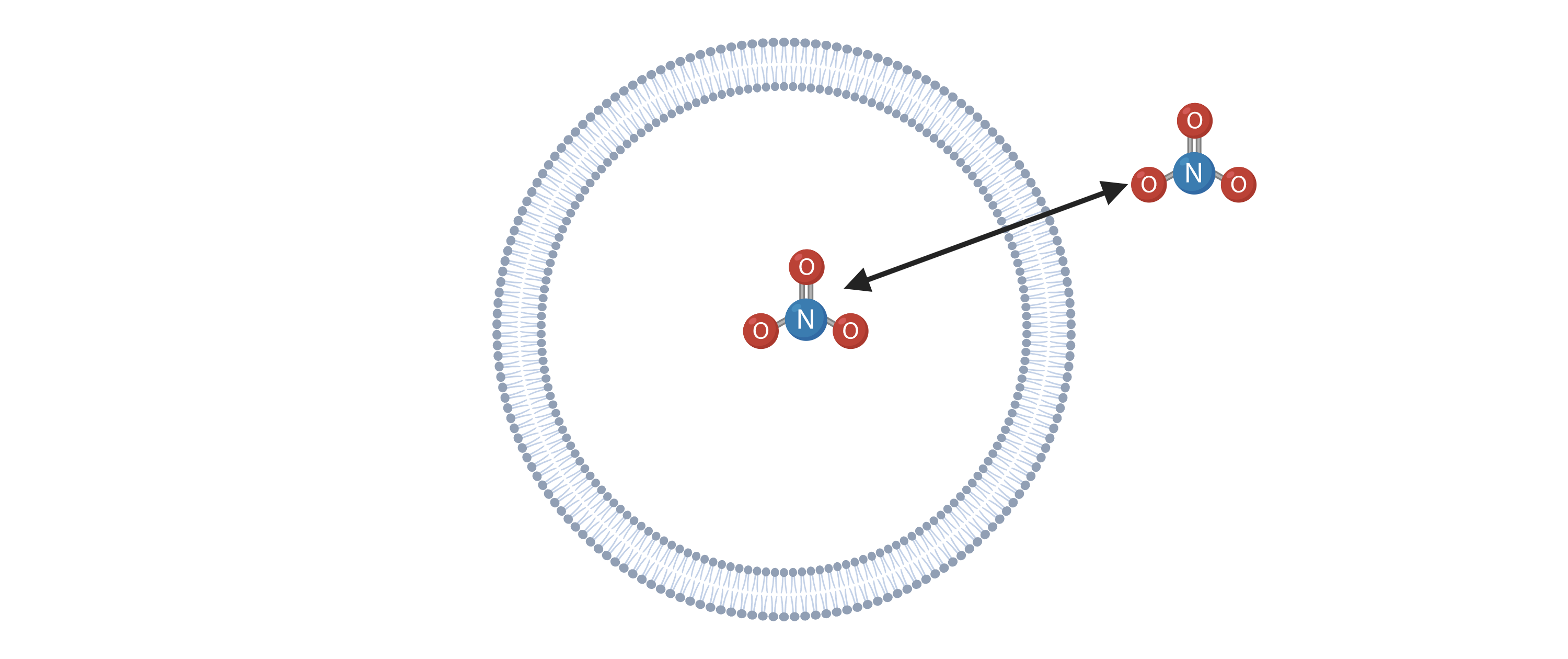
Simple diffusion across a lipid bilayer.
Consider the following diffusion step for the diffusion of nitrate (NO3).
To model the example above using the Diffusible_Molecule
component and the Simple_Diffusion mechanism, we must first
define the diffusible molecule and then incorporate it into a mixture using
the mechanism to construct a CRN.
# Define diffusible molecules
NO3 = DiffusibleMolecule('NO3')

# Mechanisms
mech_tra = Simple_Diffusion()
transport_mechanisms = {mech_tra.mechanism_type: mech_tra}

# Create mixture
M0 = Mixture("Diffusible_Molecule", components=[NO3],
             parameter_file="mechanisms/transport_parameters.tsv",
             mechanisms=transport_mechanisms)

# Compile the CRN with Mixture.compile_crn
CRN = M0.compile_crn()

# Print the CRN to see what you created
print(CRN.pretty_print())
Console Output:
Species(N = 2) = {NO3 (@ 0),  NO3 (@ 0),}

Reactions (1) = [
0. NO3 <--> NO3
 Kf=k_forward * NO3_Internal
 Kr=k_reverse * NO3_External
  k_forward=0.0002
  found_key=(mech=simple_diffusion, partid=None, name=k_diff).
  search_key=(mech=simple_diffusion, partid=NO3, name=k_diff).
  k_reverse=0.0002
  found_key=(mech=simple_diffusion, partid=None, name=k_diff).
  search_key=(mech=simple_diffusion, partid=NO3, name=k_diff).

]
7.3. Integral Membrane Protein
Component: IntegralMembraneProtein
Integral membrane proteins refer to a class of proteins embedded within the lipid bilayer of cellular membranes. These proteins typically span the membrane and play essential roles in transport, signaling, and structural support. Once integrated, they can mediate the movement of other molecules or relay signals across the membrane.
The following code defines an integral membrane protein component called
IMP. It requires two inputs: membrane_protein and product, which can
be either strings or Species objects.
# Define component
IMP = IntegralMembraneProtein(membrane_protein = "MP", product = "P")
Optional arguments may be provided to designate the direction of transport, define the stoichiometry, and specify the compartment.
IMP = IntegralMembraneProtein(
    membrane_protein = "MP",
    product = "P",
    direction = None,
    size = None,
    compartment = "Internal",
    membrane_compartment = "Membrane",
    cell = None,
    attributes = None
)
Key Optional Parameters:
direction: Specifies the transport direction with ‘Exporter’, ‘Importer’, or ‘Passive’ (default) options. The default value of ‘Passive’ indicates that the membrane protein is an integral membrane protein. This default may apply to non-transporter proteins or unidirectional transporters. The flux of the substrates, based on thedirection, follows the general transport below.Exporter: \(\text{S}_\text{in} \rightarrow \text{S}_\text{out}\)
Importer: \(\text{S}_\text{in} \leftarrow \text{S}_\text{out}\)
Passive: \(\text{S}_\text{in} \leftrightarrow \text{S}_\text{out}\)
size: Defines the number of monomers required for the integral membrane used inMembrane_Protein_Integrationand the subsequent reactions. For homo-oligomer membrane proteins, we can include an input forsizeas either a numerical string or an integer.If provided: \(\text{MP}_\text{monomer} * size \rightarrow \text{MP}_\text{oligomer} \rightarrow \text{IMP}\)
If not: \(\text{MP} \rightarrow \text{IMP}\)
Mechanism: Membrane_Protein_Integration
Membrane protein integration refers to the process by which proteins inserted are proteins are correctly localized and oriented within the membrane, a crucial step for their function in transport, signaling, or structural roles. The mechanism does not model active transport or signaling directly, but it provides the foundational step of embedding proteins into the membrane, where they can carry out these roles.
The IntegralMembraneProtein component uses the
Membrane_Protein_Integration mechanism. The mechanism for
integrating membranes can be implemented and stored in a dictionary.
# Mechanism
mech_integration = Membrane_Protein_Integration()
integration_mechanisms = {mech_integration.mechanism_type: mech_integration}
Example 2: Integration of alpha-hemolysin
Construct a chemical reaction network (CRN) for the membrane integration steps of alpha-hemolysin.
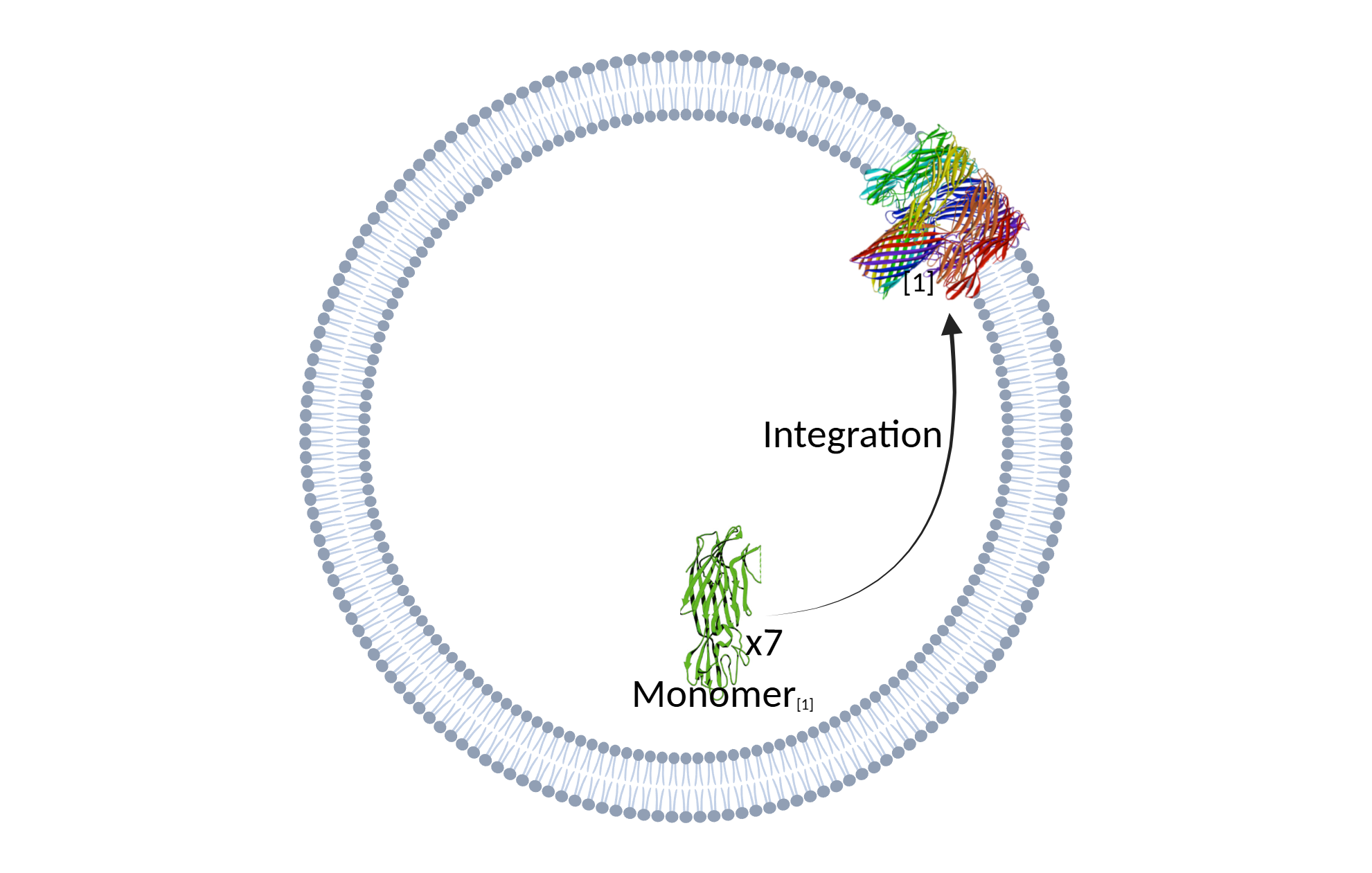
Integration of membrane proteins into the lipid bilayer.
Consider the following membrane integration steps for alpha-hemolysin.
Assemble into a homoheptamer:
Integration of membrane protein in the membrane:
To model the example above using the IntegralMembraneProtein
component and the Membrane_Protein_Integration mechanism, we
must first define the integral membrane protein (e.g., alpha-hemolysin) and
then incorporate it into a mixture using the integration mechanism to
construct a CRN.
# Define membrane protein
alphaHL = IntegralMembraneProtein(
    'alphaHL_monomer', product='alphaHL', size = 7)

# Mechanisms
mech_integration = Membrane_Protein_Integration()
integration_mechanisms = {'integration': mech_integration}

# Create mixture
    M = Mixture("alphaHL", components = [alphaHL_monomer],
                parameter_file = "mechanisms/transport_parameters.tsv",
                mechanisms = integration_mechanisms)

#Compile the CRN and print
    CRN = M.compile_crn()
    print(CRN.pretty_print())
Console Output:
Species(N = 3) = {
complex[7x_protein[alphaHL_monomer]] (@ 0),  protein[alphaHL_monomer] (@ 0),  protein[alphaHL(passive)] (@ 0),
}

Reactions (2) = [
0. 7protein[alphaHL_monomer] <--> complex[7x_protein[alphaHL_monomer]]
Kf=k_forward * protein_alphaHL_monomer_Internal^7
Kr=k_reverse * complex_protein_alphaHL_monomer_Internal_7x_
k_forward=0.002
found_key=(mech=membrane_protein_integration, partid=None, name=kb_oligmor).
search_key=(mech=membrane_protein_integration, partid=alphaHL_monomer, name=kb_oligmor).
k_reverse=2e-10
found_key=(mech=membrane_protein_integration, partid=None, name=ku_oligmor).
search_key=(mech=membrane_protein_integration, partid=alphaHL_monomer, name=ku_oligmor).

1. complex[7x_protein[alphaHL_monomer]] --> protein[alphaHL(passive)]
Kf = k complex[7x_protein[alphaHL_monomer]] / ( 1 + (protein[alphaHL(passive)]/K)^4 )
k=10.0
found_key=(mech=membrane_protein_integration, partid=None, name=kex).
search_key=(mech=membrane_protein_integration, partid=alphaHL_monomer, name=kex).
K=0.5
found_key=(mech=membrane_protein_integration, partid=None, name=kcat).
search_key=(mech=membrane_protein_integration, partid=alphaHL_monomer, name=kcat).
n=4

]
7.4. Membrane Channels
Component: MembraneChannel
Membrane channels refer to a class of proteins, a subclass of integral membrane proteins, that are pore-forming and create gated pathways across the lipid bilayer. They allow specific molecules or ions to pass through the membrane and play key roles in regulated transport, enabling the movement of substrates in response to concentration gradients or signaling events.
The following code defines a membrane channel component called MC. It
requires two inputs: integral_membrane_protein and substrate, which can
be either strings or Species objects.
# Define component
MC = MembraneChannel(integral_membrane_protein = "IMP", substrate = "S")
The component also accepts optional inputs, similar to
IntegralMembraneProtein. However, if the integral membrane
protein has already been defined using
IntegralMembraneProtein, the MembraneChannel
will inherit its direction and compartment properties from the existing
species (e.g., IMP).
The MembraneChannel component can utilize the
Simple_Transport or Facilitated_Transport_MM
mechanism. The choice of mechanism depends on the biological behavior of
the channel. You can choose from one of the following options:
Simple_Transport: Allows bidirectional movement of substrates following the concentration gradient. The direction of the membrane channel must be set to ‘Passive’.Facilitated_Transport_MM: Allows the unidirectional movement of substrates, also along concentration gradient. Thedirectionof the membrane channel must be either ‘Importer’ or ‘Exporter’.
Mechanism: Simple_Transport
Simple transport models the passive movement of substrates across the membrane through protein channels or pores. This mechanism enables molecules to move down their concentration gradient without energy input. It assumes the channel is always open or allows diffusion based on molecular properties without involving binding or conformational changes.
The Simple_Transport mechanism involves a one-step reaction
following the resulting reaction is a reversible diffusion-like process:
The mechanism for simple transport can be implemented and stored in a dictionary.
# Mechanism
mech_transport = Simple_Transport()
transport_mechanisms = {mech_transport.mechanism_type: mech_transport}
Example 3: Simple Transport by alpha-hemolysin
Construct a chemical reaction network (CRN) for the transport of ATP through alpha-hemolysin.
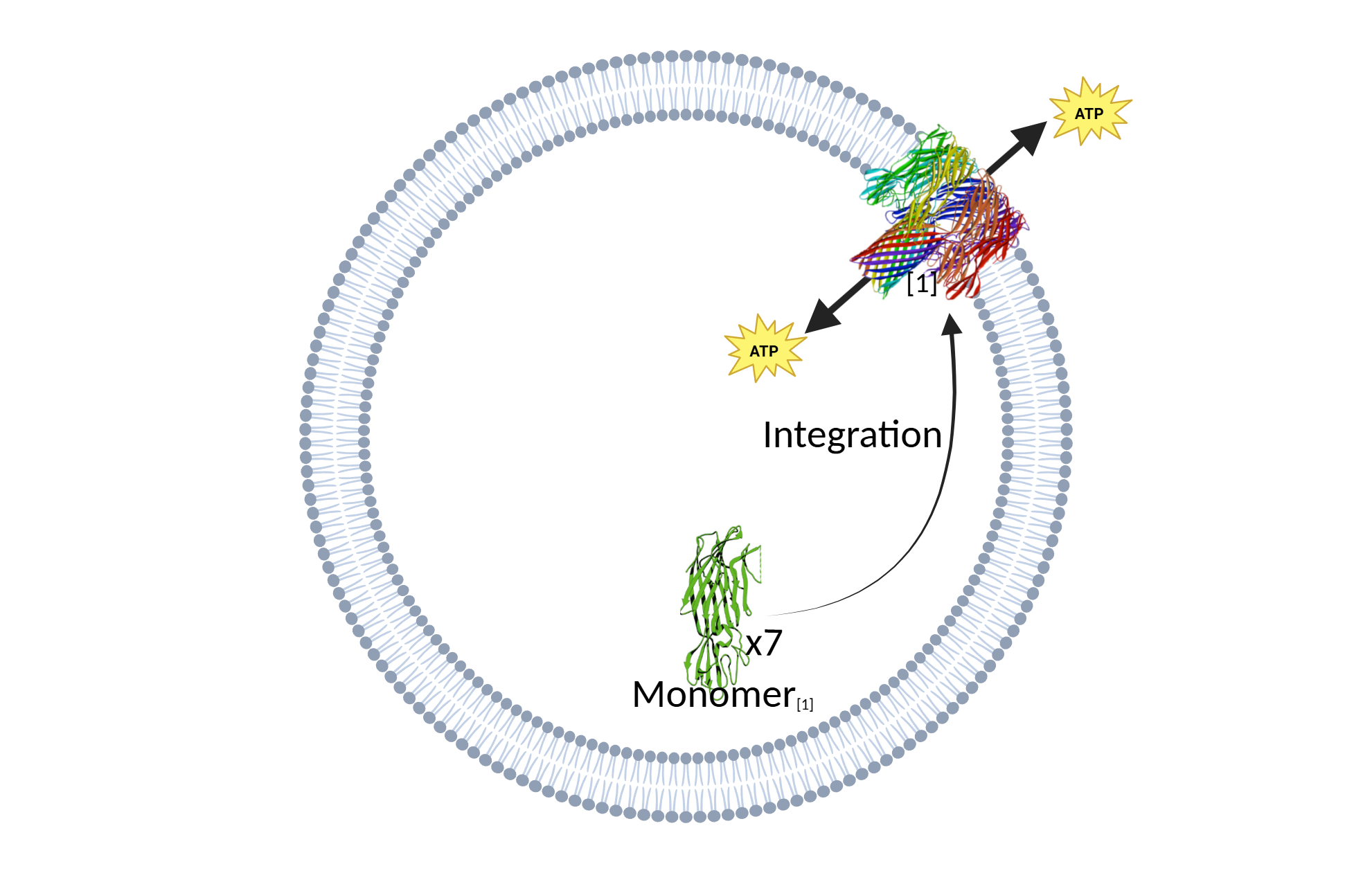
Passive transport through membrane pores or channels.
Consider the following reaction of the transport of ATP through the alpha-hemolysin pore:
To model the example above using the Membrane_Channel
component and the Simple_Transport mechanism, we use the
previously defined integral membrane protein (e.g., alphaHL) represented by
alphaHL_monomer.product and incorporate it into a mixture with the
transport mechanism to construct a CRN that enables passive transport
across the membrane.
# Define membrane channel
alphaHL_channel = MembraneChannel(alphaHL_monomer.product, substrate ="ATP")
# Mechanisms
mech_transport = Simple_Transport()
transport_mechanisms = {mech_transport.mechanism_type:mech_transport}
# Create mixture
M = Mixture("aHL_transport", components = [alphaHL_channel],
parameter_file = "mechanisms/transport_parameters.tsv",
mechanisms = transport_mechanisms)
#Compile the CRN and print
CRN = M.compile_crn()
print(CRN.pretty_print())
Console Output:
Species(N = 3) = {
protein[alphaHL(passive)] (@ 0), ATP (@ 0), ATP (@ 0),
}
Reactions (1) = [
0. ATP+protein[alphaHL(passive)] <--> ATP+protein[alphaHL(passive)]
Kf=k_forward * ATP_Internal * protein_alphaHL_passive
Kr=k_reverse * ATP_External * protein_alphaHL_passive
k_forward=0.1
k_reverse=0.1
]
Mechanism: Facilitated_Transport_MM
Facilitated transport refers to the movement of substrates across a membrane with the assistance of specific carrier proteins. These proteins bind to the substrate and undergo conformational changes, allowing the molecule to move from one side of the membrane to the other. Although no energy is required, the process is selective and directional, following the concentration gradient of the substrate.
The Facilitated_Transport_MM mechanism involves binding,
translocation, and unbinding steps. For example, if the membrane channel is
an ‘Importer’, the resulting reactions are:
Binding and transport of substrate (S) across the membrane:
Unbinding substrate from transporter:
To use Facilitated_Transport_MM, we need to redefine the membrane
channel to include a transport direction designation, such as ‘Importer’ or
‘Exporter’. For example:
# Define component
MC = MembraneChannel(
integral_membrane_protein = "IMP", substrate = "S",
direction = 'Importer')
Then, the mechanism for facilitated transport can be implemented and stored in a dictionary.
# Mechanism
mech_transport = Facilitated_Transport()
transport_mechanisms = {mech_transport.mechanism_type: mech_transport}
Example 4: Facilitated transport of glucose by GLUT1
Construct a chemical reaction network (CRN) for the transport of glucose through the membrane channel glucose transporter type 1 (GLUT1).
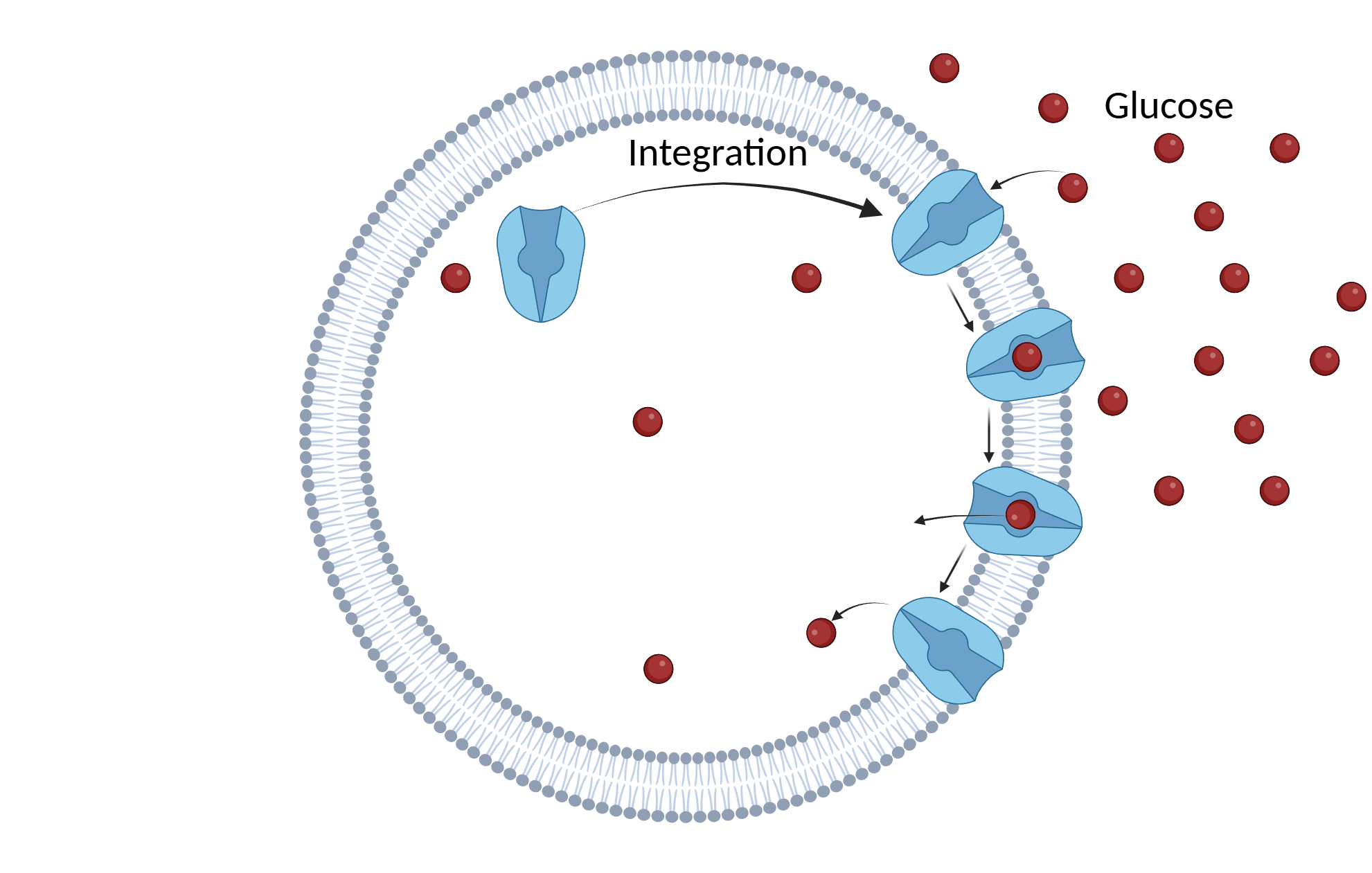
Facilitated diffusion via carrier proteins.
Consider the following reactions of the transport of glucose by GLUT1.
Integration of membrane protein in the membrane:
Binding and transport of glucose across the membrane:
Unbinding glucose from transporter:
To model the example above using the MembraneChannel
component and the Facilitated_Transport_MM mechanism, we can
either redefine the Membrane_Channel component or the
integral membrane protein GLUT1 using the
IntegralMembraneProtein component to incorporate
directionality.
The following example begins by defining the integral membrane protein, including the specification of its transport direction.
# Define integral membrane protein
glut1 = IntegralMembraneProtein('glut1', product='glut1_channel',
                                direction='Importer', size= 1)

# Define membrane channel
glut1_channel = MembraneChannel(glut1.product, substrate='glucose')

# Mechanisms
mech_integration = Membrane_Protein_Integration()
mech_transport = Facilitated_Transport_MM()

all_mechanisms = {mech_integration.mechanism_type:mech_integration,
                mech_transport.mechanism_type:mech_transport}

# Create mixture
M = Mixture(components=[glut1, glut1_channel],
    mechanisms=all_mechanisms,
    parameter_file = "mechanisms/transport_parameters.tsv")

# Compile the CRN and print
CRN = M.compile_crn()
print(CRN.pretty_print(show_keys=False))
Console Output:
Species(N = 6) = {
protein[glut1_channel(importer)] (@ 0),  protein[glut1] (@ 0),  complex[glucose:protein[glut1_channel]] (@ 0),
complex[glucose:protein[glut1_channel]] (@ 0),  glucose (@ 0),  glucose (@ 0),
}

Reactions (5) = [
0. protein[glut1] --> protein[glut1_channel(importer)]
Kf = k protein[glut1] / ( 1 + (protein[glut1_channel(importer)]/K)^4 )
k=10.0
K=0.5
n=4

1. glucose+protein[glut1_channel(importer)] --> complex[glucose:protein[glut1_channel]]
kb_subMC*glucose_External*protein_glut1_channel_importer*Heaviside(glucose_External-glucose_Internal)-kb_subMC*glucose_Internal*protein_glut1_channel_importer*Heaviside(glucose_External-glucose_Internal)
kb_subMC=0.1

2. complex[glucose:protein[glut1_channel]] --> protein[glut1_channel(importer)]+glucose
Kf=k_forward * complex_glucose_External_protein_glut1_channel_importer_
k_forward=0.1

3. complex[glucose:protein[glut1_channel]] --> complex[glucose:protein[glut1_channel]]
Kf=k_forward * complex_glucose_External_protein_glut1_channel_importer_
k_forward=0.01

4. complex[glucose:protein[glut1_channel]] --> glucose+protein[glut1_channel(importer)]
Kf=k_forward * complex_glucose_Internal_protein_glut1_channel_importer_
k_forward=0.1

]
7.5. Membrane Pumps
Component: MembranePump
Membrane pumps are a class of transport proteins, also considered a subclass of integral membrane proteins, that actively move molecules or ions across the lipid bilayer. Unlike passive channels, pumps use energy, typically from ATP or an electrochemical gradient, to drive the transport of substrates against their concentration gradients.
The following code defines a membrane pump component called MC. It
requires two inputs: integral_membrane_protein and substrate, which can
be either strings or Species objects.
# Define component
MP = MembranePump(membrane_pump = "MP", substrate = "S")
The component also accepts optional inputs, similar to
IntegralMembraneProtein. If the integral membrane protein
was previously defined using the component
IntegralMembraneProtein, then the MembranePump
will inherit its direction and compartment properties from the existing
species (e.g., IMP).
Additionally, optional arguments can be provided to control the transport direction, stoichiometry, and compartment.
MP = MembranePump(membrane_pump = "MP", substrate = "S",
                direction = None,
                internal_compartment ='Internal',
                external_compartment ='External',
                ATP = None, cell = None, attributes=None)
Key Optional Parameters:
ATP: Specifies the necessary amount of ATP needed for transport to take place. In the absence of a specified integer value forATP, the model defaults to a value of 1.direction: By default, thedirectionis set toNone, generating a CRN corresponding to an exporter.
The MembranePump component uses the
Primary_Active_Transport_MM mechanism.
Mechanism: Primary_Active_Transport_MM
Primary active transport refers to the energy-dependent movement of substrates across the membrane, typically against their concentration gradient. This process involves specialized membrane pumps that attach to the substrate and undergo conformational changes driven by the hydrolysis of ATP. The transport mechanism is both selective and directional.
The Primary_Active_Transport_MM mechanism captures this
behavior through binding, energy-driven conformational changes, and
unbinding steps. For example, if the membrane pump is classified as an
exporter, the resulting reactions are:
Binding of antibiotic substrate (S) to membrane pump (MP):
Binding of ATP to the complex of S with MP:
Export of S from the internal compartment to the external compartment:
Unbinding of S:
Unbinding of ADP from MP:
To use Primary_Active_Transport_MM, we need to redefine the
membrane channel to include a transport direction designation, such as
‘Importer’ or ‘Exporter’. For example:
# Define component
MC = MembraneChannel(integral_membrane_protein = "IMP", substrate = "S",
                     direction = 'Importer')
Then, the mechanism for facilitated transport can be implemented and stored in a dictionary.
# Mechanism
mech_transport = Primary_Active_Transport_MM()
transport_mechanisms = {mech_transport.mechanism_type: mech_transport}
Example 5: Export of erythromycin by MsbA
Construct a chemical reaction network (CRN) for the export of the antibiotic erythromycin driven by the membrane pump MsbA.
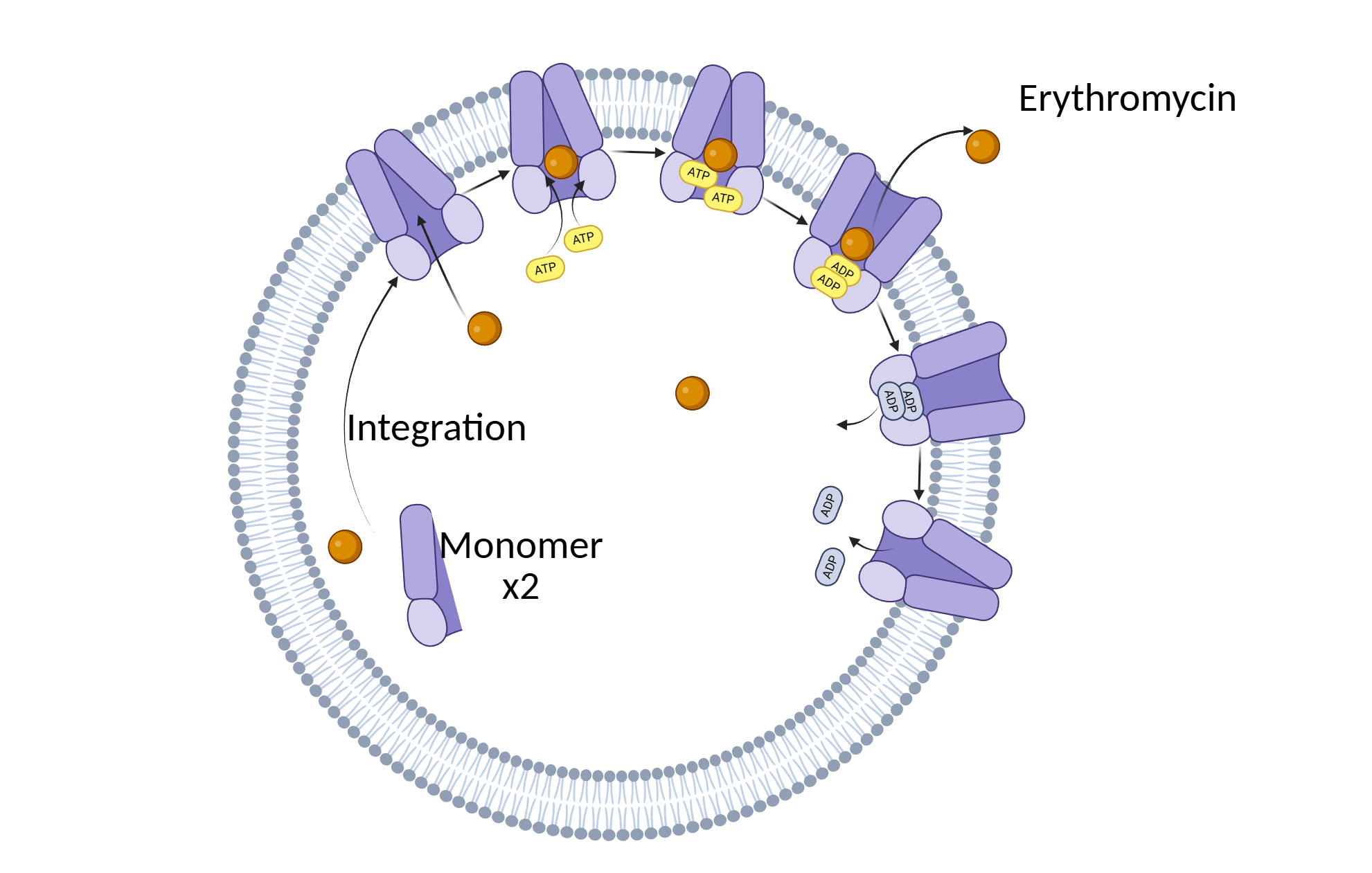
Primary active transport using membrane pumps.
Consider the following reactions for the export of erythromycin by MsbA.
Integration of membrane protein in the membrane:
Binding of antibiotic (Abx) substrate (e.g., erythromycin) to MsbA transporter:
Binding of ATP to a complex of erythromycin with MsbA:
Export of erythromycin lipid from inner membrane to outer membrane:
Unbinding of erythromycin:
Unbinding of ADP from MsbA:
To model the example above using the MembranePump component
and the Primary_Active_Transport_MM mechanism, we can either
define the pump directly or specify the integral membrane protein (e.g.,
MsbA) using the IntegralMembraneProtein component to
incorporate transport directionality.
The following example begins by defining the integral membrane protein, including the specification of its direction (e.g., ‘Exporter’).
# Define integral membrane protein
MsbA = IntegralMembraneProtein('MsbA', product='MsbA_pump',
                                direction='Exporter', size= 2)

# Define membrane pump
MsbA_pump = MembranePump(MsbA.product, substrate = 'abx', ATP = 2)

# Mechanisms
mech_integration = Membrane_Protein_Integration()
mech_transport = Membrane_Protein_Integration()

all_mechanisms = {mech_integration.mechanism_type:mech_integration,
                mech_transport.mechanism_type:mech_transport}

# Create mixture
M = Mixture(components = [MsbA, MsbA_pump,],
    mechanisms = all_mechanisms,
    parameter_file = "mechanisms/transport_parameters.tsv")

# Compile the CRN and print
CRN = M.compile_crn()
print(CRN.pretty_print(show_keys = False))
Console Output:
Species(N = 11) = {
complex[protein[MsbA_pump]:2x_small_molecule[ADP]] (@ 0),  complex[2x_protein[MsbA]] (@ 0),  complex[complex[abx:protein[MsbA_pump]]:2x_small_molecule[ATP]] (@ 0),  complex[abx:protein[MsbA_pump]] (@ 0),  complex[abx:protein[MsbA_pump]:2x_small_molecule[ATP]] (@ 0),  abx (@ 0),  abx (@ 0),  protein[MsbA_pump(exporter)] (@ 0),  protein[MsbA] (@ 0),  small_molecule[ATP] (@ 0),  small_molecule[ADP] (@ 0),
}

Reactions (9) = [
0. 2protein[MsbA] <--> complex[2x_protein[MsbA]]
Kf=k_forward * protein_MsbA_Internal^2
Kr=k_reverse * complex_protein_MsbA_Internal_2x_
k_forward=0.002
k_reverse=2e-10

1. complex[2x_protein[MsbA]] --> protein[MsbA_pump(exporter)]
Kf = k complex[2x_protein[MsbA]] / ( 1 + (protein[MsbA_pump(exporter)]/K)^4 )
k=10.0
K=0.5
n=4

2. abx+protein[MsbA_pump(exporter)] --> complex[abx:protein[MsbA_pump]]
kb_subMP*abx_Internal*protein_MsbA_pump_exporter*Heaviside(protein_MsbA_pump_exporter)
kb_subMP=0.1

3. complex[abx:protein[MsbA_pump]] --> abx+protein[MsbA_pump(exporter)]
Kf=k_forward * complex_abx_Internal_protein_MsbA_pump_exporter_
k_forward=0.1

4. complex[abx:protein[MsbA_pump]]+2small_molecule[ATP] --> complex[complex[abx:protein[MsbA_pump]]:2x_small_molecule[ATP]]
kb_subMPnATP*complex_abx_Internal_protein_MsbA_pump_exporter_*small_molecule_ATP_Internal*Heaviside(complex_abx_Internal_protein_MsbA_pump_exporter_)
kb_subMPnATP=0.1

5. complex[complex[abx:protein[MsbA_pump]]:2x_small_molecule[ATP]] --> complex[abx:protein[MsbA_pump]]+2small_molecule[ATP]
Kf=k_forward * complex_complex_abx_Internal_protein_MsbA_pump_exporter__small_molecule_ATP_Internal_2x_
k_forward=0.01

6. complex[complex[abx:protein[MsbA_pump]]:2x_small_molecule[ATP]] --> complex[abx:protein[MsbA_pump]:2x_small_molecule[ATP]]
Kf=k_forward * complex_complex_abx_Internal_protein_MsbA_pump_exporter__small_molecule_ATP_Internal_2x_
k_forward=0.01

7. complex[abx:protein[MsbA_pump]:2x_small_molecule[ATP]] --> complex[protein[MsbA_pump]:2x_small_molecule[ADP]]+abx
Kf=k_forward * complex_abx_External_protein_MsbA_pump_exporter_small_molecule_ATP_Internal_2x_
k_forward=0.1

8. complex[protein[MsbA_pump]:2x_small_molecule[ADP]] --> 2small_molecule[ADP]+protein[MsbA_pump(exporter)]
Kf=k_forward * complex_protein_MsbA_pump_exporter_small_molecule_ADP_Internal_2x_
k_forward=0.1

]
7.6. Membrane Sensors
Component: MembraneSensor
Membrane sensors are a type of membrane protein classified as a subgroup of integral membrane proteins. These proteins are designed to detect external signals or environmental changes at the cell surface. Typically, these sensors are part of larger signaling systems, such as two-component systems. They initiate signal transduction pathways by responding to specific stimuli, including chemical ligands, changes in osmotic pressure, or shifts in pH. When activated, membrane sensors often undergo conformational changes or autophosphorylation, which triggers downstream responses within the cell.
The following code defines a membrane sensor component called
MembraneSensor. This component requires four inputs:
membrane_sensor_protein: the membrane-bound sensor protein (e.g., a histidine kinase)response_protein: the cytoplasmic response regulatorassigned_substrate: the substrate to which the sensor is assigned or respondssignal_substrate: the substrate that acts as the external signal or inducer
# Define component
Membrane_sensor = MembraneSensor(
    membrane_sensor_protein = "IMP",
    response_protein = "RP",
    assigned_substrate = "S_assigned",
    signal_substrate = "S_signal"
)
Key Optional Parameters:
ATP: an integer representing the number of ATP molecules required for phosphorylation events. The default value is 2 if not explicitly specified.
The MembraneSensor component utilizes the
Membrane_Signaling_Pathway_MM mechanism to model
two-component signaling systems, where signal detection at the membrane
results in phosphorylation-driven regulatory responses within the cell.
Mechanism: Membrane_Signaling_Pathway_MM
The Membrane Signaling Pathway models the two-component signaling process, allowing cells to detect and respond to external environmental signals using a membrane-bound sensor kinase and a cytoplasmic response regulator. This mechanism facilitates signal transduction without the need for direct substrate transport across the membrane. When the sensor kinase detects a stimulus, it undergoes autophosphorylation, transferring a phosphate group to the response regulator. This transfer initiates downstream cellular responses.
The Membrane_Signaling_Pathway_MM mechanism captures
two-component signaling behavior using Michaelis-Menten kinetics to model
key steps such as stimulus detection, sensor autophosphorylation, and
phosphate transfer to a response regulator. The following reactions
illustrate the signaling pathway modeled by the
Membrane_Signaling_Pathway_MM mechanism. These steps follow
Michaelis-Menten dynamics to represent enzymatic interactions such as
substrate binding, phosphorylation, and dephosphorylation.
Signal detection and binding of the signal substrate (S_sig) to the membrane sensor (M_sensor):
Auto-phosphorylation of the membrane sensor via ATP binding:
Phosphorylation of the response protein (RP):
Dephosphorylation of the phosphorylated response protein (RP*):
Then, the mechanism for membrane signaling can be implemented and stored in a dictionary.
# Mechanism
    mech_sensor = Membrane_Signaling_Pathway_MM()
    sensor_mechanisms = {mech_sensor.mechanism_type:mech_sensor}
Example 6: NarX-NarL two-component signaling path
Construct a chemical reaction network (CRN) for the NarX–NarL two-component signaling pathway.
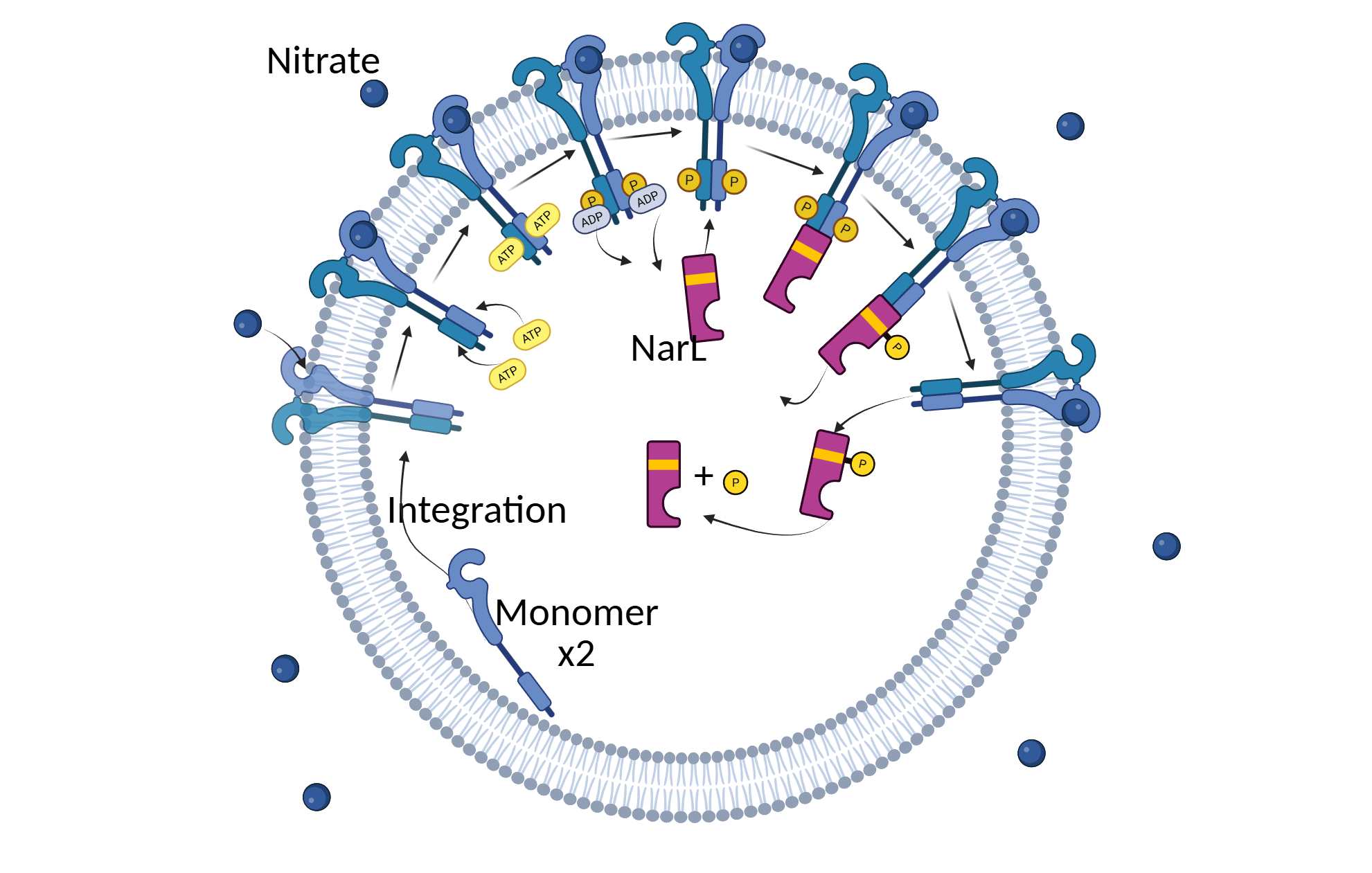
Membrane-associated two-componentent signaling pathway.
Use the reaction steps as a guide to define the necessary components and mechanisms for simulating this signaling cascade.
Homodimerization of NarX monomers:
Integration of NarX homodimer into the membrane:
Detection and binding of nitrate:
Auto-phosphorylation of activated NarX sensor:
Phosphorylation of the response regulator NarL:
Dephosphorylation of phosphorylated NarL (NarL*):
To model the example above using the MembraneSensor component
and the Membrane_Signaling_Pathway_MM mechanism, we can begin
by defining a new integral membrane protein (e.g., NarX) using the
IntegralMembraneProtein component. This protein will serve as
the membrane-bound sensor in the signaling pathway.
The following example begins by defining the integral membrane protein, followed by the membrane sensor. Both components are combined to form a mixture, which includes the response regulator and relevant signaling substrates.
# Define integral membrane protein
NarX = IntegralMembraneProtein('NarX', product='NarX_sensor',
                            size = 2)

# Define membrane sensor
NarX_sensor = MembraneSensor(
    NarX.product, response_protein = 'NarL',
    assigned_substrate = 'P', signal_substrate = 'NO3', ATP = 2)

# Mechanisms
mech_integration = Membrane_Protein_Integration()
mech_sensing = Membrane_Signaling_Pathway_MM()

all_mechanisms = {mech_integration.mechanism_type:mech_integration,
                mech_sensing.mechanism_type:mech_sensing}

# Create mixture
M = Mixture(
    components = [NarX, NarX_sensor],
    mechanisms = all_mechanisms,
    parameter_file = "mechanisms/transport_parameters.tsv")

#Compile the CRN and print
CRN = E.compile_crn()
print(CRN.pretty_print(show_keys = False))
Console Output:
Species(N = 15) = {
complex[2x_protein[NarX]] (@ 0),  complex[complex[NO3:protein[NarX_sensor]]:2x_small_molecule[ATP]] (@ 0),  complex[P:complex[NO3:protein[NarX_sensor]]:2x_small_molecule[ADP]] (@ 0),  complex[P:complex[NO3:protein[NarX_sensor]]] (@ 0),  P (@ 0),  protein[NarX_sensor(passive)] (@ 0),  protein[NarX] (@ 0),  NarLactive (@ 0),  complex[NarL:complex[P:complex[NO3:protein[NarX_sensor]]]] (@ 0),  complex[NarL:P:complex[NO3:protein[NarX_sensor]]] (@ 0),  NarL (@ 0),  complex[NO3:protein[NarX_sensor]] (@ 0),  NO3 (@ 0),  small_molecule[ATP] (@ 0),  small_molecule[ADP] (@ 0),
}

Reactions (10) = [
0. 2protein[NarX] <--> complex[2x_protein[NarX]]
Kf=k_forward * protein_NarX_Internal^2
Kr=k_reverse * complex_protein_NarX_Internal_2x_
k_forward=0.002
k_reverse=2e-10

1. complex[2x_protein[NarX]] --> protein[NarX_sensor(passive)]
Kf = k complex[2x_protein[NarX]] / ( 1 + (protein[NarX_sensor(passive)]/K)^4 )
k=10.0
K=0.5
n=4

2. NO3+protein[NarX_sensor(passive)] <--> complex[NO3:protein[NarX_sensor]]
Kf=k_forward * NO3_Internal * protein_NarX_sensor_passive
Kr=k_reverse * complex_NO3_Internal_protein_NarX_sensor_passive_
k_forward=0.002
k_reverse=2e-10

3. complex[NO3:protein[NarX_sensor]]+2small_molecule[ATP] <--> complex[complex[NO3:protein[NarX_sensor]]:2x_small_molecule[ATP]]
Kf=k_forward * complex_NO3_Internal_protein_NarX_sensor_passive_ * small_molecule_ATP_Internal^2
Kr=k_reverse * complex_complex_NO3_Internal_protein_NarX_sensor_passive__small_molecule_ATP_Internal_2x_
k_forward=0.002
k_reverse=2e-10

4. complex[complex[NO3:protein[NarX_sensor]]:2x_small_molecule[ATP]] --> complex[P:complex[NO3:protein[NarX_sensor]]:2x_small_molecule[ADP]]
Kf=k_forward * complex_complex_NO3_Internal_protein_NarX_sensor_passive__small_molecule_ATP_Internal_2x_
k_forward=0.1

5. complex[P:complex[NO3:protein[NarX_sensor]]:2x_small_molecule[ADP]] --> complex[P:complex[NO3:protein[NarX_sensor]]]+2small_molecule[ADP]
Kf=k_forward * complex_P_Internal_complex_NO3_Internal_protein_NarX_sensor_passive__small_molecule_ADP_Internal_2x_
k_forward=0.8

6. complex[P:complex[NO3:protein[NarX_sensor]]]+NarL <--> complex[NarL:complex[P:complex[NO3:protein[NarX_sensor]]]]
Kf=k_forward * complex_P_Internal_complex_NO3_Internal_protein_NarX_sensor_passive__ * NarL_Internal
Kr=k_reverse * complex_NarL_Internal_complex_P_Internal_complex_NO3_Internal_protein_NarX_sensor_passive___
k_forward=0.002
k_reverse=1e-10

7. complex[NarL:complex[P:complex[NO3:protein[NarX_sensor]]]] --> complex[NarL:P:complex[NO3:protein[NarX_sensor]]]
Kf=k_forward * complex_NarL_Internal_complex_P_Internal_complex_NO3_Internal_protein_NarX_sensor_passive___
k_forward=0.1

8. complex[NarL:P:complex[NO3:protein[NarX_sensor]]] --> NarLactive+complex[NO3:protein[NarX_sensor]]
Kf=k_forward * complex_NarL_Internal_P_Internal_complex_NO3_Internal_protein_NarX_sensor_passive__
k_forward=0.2

9. NarLactive --> NarL+P
Kf=k_forward * NarLactive_Internal
k_forward=2e-10

]
7.7. References
L.Song et al., Structure of Staphylococcal Alpha-Hemolysin, a Heptameric Transmembrane Pore. Science , 1996.
L. Sun et al., Crystal structure of a bacterial homologue of glucose transporters GLUT1-4. Nature, 2012.
I. Josts et al., Conformational States of ABC Transporter MsbA in a Lipid Environment Investigated by Small-Angle Scattering Using Stealth Carrier Nanodiscs. Structure, 2018.
J. Cheung and W. A. Hendrickson, Structural analysis of ligand stimulation of the histidine kinase NarX. Structure, 2009.
Footnotes